How to Read Japanese Sunscreen Labels: SPF and PA (PA+ to PA++++) Explained
Disclosure: This guide contains no affiliate links. Some posts on Under ¥2000 Japan do, and if you buy through them we may earn a small commission at no extra cost to you. We have not tested the products mentioned here; label details come from the makers’ official pages.
Pick up almost any sunscreen in a Japanese drugstore and you’ll see something like SPF50+ / PA++++ printed on the front. SPF is familiar if you shop in the US, UK, Canada or Australia. But what about “PA” and all those plus signs?
This guide explains both numbers in plain English, shows you the official PA scale in a simple table, and gives you a cheat sheet for the Japanese words you’ll find on the tube. It’s a how-to, not a product roundup. If you’re looking for picks and prices, see our Japanese drugstore beauty under ¥2000 guide.
This article is general information, not medical advice. If you have a skin condition or questions about sun protection for you or your family, talk to a doctor or pharmacist.
First, a 30-second primer on UVA and UVB
Sunlight contains two kinds of ultraviolet (UV) rays that matter for sunscreen:
- UVB is the primary cause of sunburn, according to the World Health Organization.
- UVA penetrates deeper into the skin and darkens pigment to create a tan, and the WHO also links it to gradual loss of skin elasticity (WHO).
The US FDA notes that both UVA and UVB can damage your skin (FDA). That’s why a Japanese label gives you two ratings: SPF (mostly about UVB) and PA (about UVA).
What SPF means
SPF stands for Sun Protection Factor. According to the FDA, the SPF value “indicates the level of sunburn protection provided by the sunscreen product,” and because it comes from a sunburn test, SPF “primarily” indicates a sunscreen’s UVB protection.
A few things worth knowing:
- SPF is not a timer. The FDA explains that SPF relates to the amount of sun exposure, not the time. “SPF 15 = 15 times longer in the sun” is a myth (FDA).
- Japan measures SPF with an international method. The Japan Cosmetic Industry Association (JCIA) says SPF is measured using ISO 24444, an international standard, and the JCIA sets how it is displayed on labels (JCIA).
- You’ll often see “SPF50+”. All three sunscreens in our article 1 carry it, according to their makers (details below).
What PA means
PA is a rating for UVA protection. It’s shown with plus signs, from PA+ up to PA++++. More plus signs mean a higher measured UVA protection value.
Here’s how it works:
- The number behind the rating is called UVA-PF (UVA protection factor). Japan measures it with the international standard ISO 24442 (JCIA).
- The measurement method is international, but the PA+ to PA++++ notation itself is Japan’s own system, set as a voluntary industry standard by the JCIA (JCIA; Journal of Society of Cosmetic Chemists of Japan, J-STAGE).
- Under the JCIA UVA standard, PA must be shown together with SPF (JCIA UVA standard, 2012 revision, PDF). That’s why you almost always see them side by side.
The PA scale: PA+ to PA++++
The JCIA’s 2012 revision of its UVA standard sets these grades (JCIA PDF):
| PA rating | UVA-PF (measured value) |
|---|---|
| PA+ | 2 to less than 4 |
| PA++ | 4 to less than 8 |
| PA+++ | 8 to less than 16 |
| PA++++ | 16 or more |
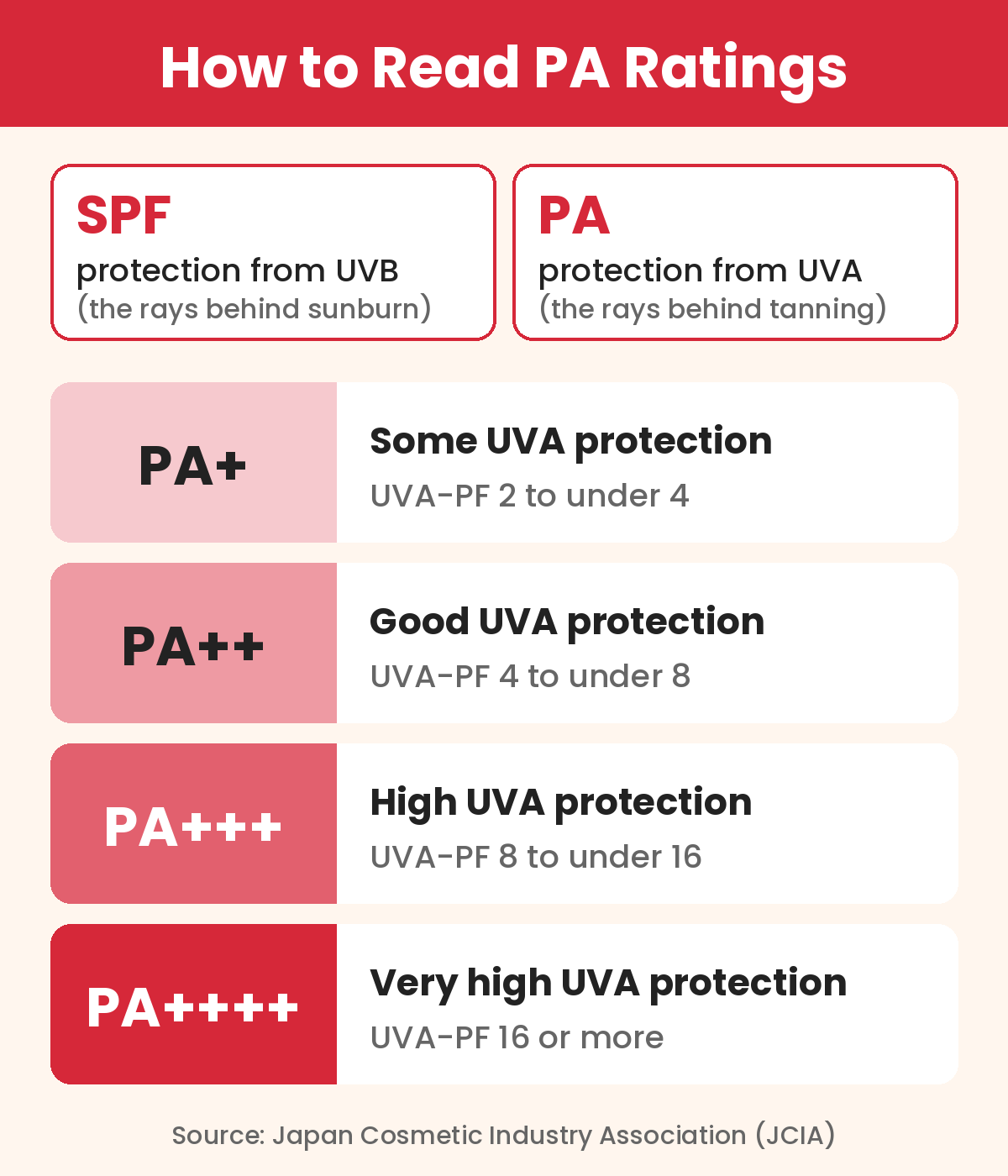
Note: PA++++ is the highest grade on the scale. It means the product measured at UVA-PF 16 or higher, so two PA++++ products may not have the same measured value.
SPF vs PA, side by side
| SPF | PA | |
|---|---|---|
| Mainly about | UVB (sunburn) (FDA) | UVA (linked to tanning) (WHO) |
| How it’s shown | A number, e.g. SPF30, SPF50+ | Plus signs, PA+ to PA++++ |
| Test method | ISO 24444 (JCIA) | ISO 24442 (JCIA) |
| Used outside Japan? | Yes, widely | The plus-sign notation is Japanese (J-STAGE) |
What about “broad spectrum”? In the US, the label to look for is “broad spectrum,” which means the sunscreen helps protect against both UVA and UVB (FDA). Japanese tubes usually don’t say “broad spectrum.” Instead, the PA rating tells you about UVA.
How to choose: everyday use vs outdoor days
We’re not doctors, so here is general guidance from official sources rather than our own recommendations:
- Use enough, and reapply. The FDA suggests applying sunscreen 15 minutes before going out, using enough to cover all exposed skin (about one ounce, a shot glass, for the body), and reapplying at least every two hours, more often if you’re sweating or swimming (FDA).
- Minimum level. The FDA recommends a broad-spectrum sunscreen with SPF 15 or higher (FDA). The US CDC gives the same SPF 15+ advice (CDC).
- Sunscreen is only one part. The WHO says sun protection is best achieved by seeking shade and wearing clothes, and that sunscreen shouldn’t be used to extend time in the sun (WHO). The FDA also advises limiting sun between 10 a.m. and 2 p.m. and wearing hats and long sleeves (FDA).
- Clouds don’t switch it off. You can still get sunburned on a cloudy day (FDA).
- Swimming or sweating? Look at water resistance (see the label words below). Even so, the FDA notes that no sunscreen is truly “waterproof” (FDA).
- Babies. The FDA says sunscreen isn’t recommended for infants under six months; ask a doctor first (FDA).
In short: for a commute, the “right” product is mostly about one you’ll actually wear and reapply. For a beach or hiking day, add shade, clothing, water resistance, and frequent reapplication. Many popular Japanese drugstore sunscreens are SPF50+ / PA++++ anyway, so the bigger difference is usually how you use them.
How to read a Japanese sunscreen label
Here are words you’re likely to see on the tube or box:
| Japanese | Reading | Meaning |
|---|---|---|
| 日焼け止め / 日やけ止め | hiyakedome | Sunscreen |
| 紫外線 | shigaisen | Ultraviolet (UV) rays |
| UVカット | yū-bui katto | UV-blocking (marketing term) |
| 顔・からだ用 | kao karada-yō | For face and body |
| 化粧下地 / 下地 | keshō shitaji | Makeup base / primer |
| UV耐水性★★ | yū-bui taisuisei | UV water resistance rating, shown with stars |
| ウォータープルーフ | wōtā purūfu | Waterproof (marketing term) |
| 石けんで落とせる | sekken de otoseru | Removable with soap |
| トーンアップ | tōn appu | Tone-up (brightening makeup effect) |
| 医薬部外品 | iyaku-bugaihin | Quasi-drug (a Japanese category between cosmetics and medicine) |
| 化粧品 | keshōhin | Cosmetic |
| アレルギーテスト済み | arerugī tesuto-zumi | Allergy-tested |
About UV耐水性 (UV water resistance): the JCIA introduced a water-resistance test based on ISO 18861, which compares SPF before and after a water test, and set a voluntary standard for how to show it on labels (JCIA). On real products it appears as stars, for example “UV耐水性★★” on the Biore and Skin Aqua pages linked below.
Example: the three sunscreens from our article 1
Here’s what the makers’ official pages say. We have not tested these products ourselves.
| Product | Label (official) | Source |
|---|---|---|
| Biore UV Aqua Rich Watery Essence (ビオレUV アクアリッチ ウォータリーエッセンス) | SPF50+ / PA++++, UV耐水性★★ | Kao official |
| Skin Aqua Tone Up UV Essence (スキンアクア トーンアップUVエッセンス) | SPF50+ / PA++++, UV耐水性★★ | Rohto official |
| Canmake Mermaid Skin Gel UV (キャンメイク マーメイドスキンジェルUV) | SPF50+ / PA++++ | Canmake official |
Prices, sizes and where to buy them overseas are in our Japanese drugstore beauty under ¥2000 guide. Versions sold outside Japan may be labeled differently, so check the listing.
FAQ
Is PA++++ the highest rating?
Yes. PA++++ means a measured UVA-PF of 16 or more, the top grade in the JCIA standard (JCIA PDF).
Is PA only used in Japan?
The PA+ to PA++++ notation is Japan’s own system, though the measurement method (ISO 24442) is international (JCIA; J-STAGE).
Does SPF50+ mean I can stay out all day?
No. The FDA says SPF isn’t related to time in the sun, and recommends reapplying at least every two hours (FDA).
Is a Japanese sunscreen the same as a US one?
Not legally. In the US, sunscreens are regulated as drugs, while some countries regulate them differently, e.g. as cosmetics. The FDA advises reading the label to understand differences if you buy sunscreen abroad (FDA).
Final thoughts
Once you know the code, a Japanese sunscreen label is easy to read: SPF is mostly about UVB and sunburn, PA is about UVA, and more plus signs mean higher measured UVA protection. Add a few label words like 日焼け止め, UV耐水性 and 石けんで落とせる, and you’ll know what you’re holding, even if you can’t read the rest of the tube.
Curious why so many people shop Japanese sunscreen and skincare in the first place? Read Why choose Japanese skincare?
Sources
- Japan Cosmetic Industry Association (JCIA), UVA protection measurement standard, 2012 revision (PDF): https://www.jcia.org/user/common/download/business/guideline/uva/UVA-jcia-h240620.pdf
- JCIA, UV protection standards page (ISO 24444, ISO 24442, ISO 18861): https://www.jcia.org/user/business/guideline/uvprotection
- Journal of Society of Cosmetic Chemists of Japan (J-STAGE): https://www.jstage.jst.go.jp/article/koshohin/41/1/41_44/_pdf
- US FDA, Sunscreen: How to Help Protect Your Skin from the Sun: https://www.fda.gov/drugs/understanding-over-counter-medicines/sunscreen-how-help-protect-your-skin-sun
- US FDA, Ultraviolet (UV) Radiation: https://www.fda.gov/radiation-emitting-products/tanning/ultraviolet-uv-radiation
- WHO, The known health effects of ultraviolet radiation: https://www.who.int/news-room/questions-and-answers/item/radiation-the-known-health-effects-of-ultraviolet-radiation
- WHO, Ultraviolet radiation fact sheet: https://www.who.int/news-room/fact-sheets/detail/ultraviolet-radiation/
- US CDC, Ultraviolet Radiation: https://www.cdc.gov/radiation-health/features/uv-radiation.html
- Kao, Biore UV Aqua Rich Watery Essence (press release): https://www.kao.com/jp/newsroom/news/release/2024/20241211-002/
- Rohto, Skin Aqua Tone Up UV Essence: https://jp.rohto.com/skin-aqua/tone-up-essence
- Canmake, Mermaid Skin Gel UV: https://www.canmake.com/item/detail/mermaid-skin-gel-uv/