Why Choose Japanese Skincare? 5 Practical Advantages of Japanese Drugstore Beauty
Disclosure: This guide contains no affiliate links. Some posts on Under ¥2000 Japan do, and if you buy through them we may earn a small commission at no extra cost to you. We have not tested the products mentioned here.
Japanese drugstore skincare has a loyal following overseas. But “Japanese skincare is just better” isn’t a fair or provable claim, and we won’t make it here. Products from every country can be great or not great for your skin, and results vary from person to person.
What we can do is look at the facts: how Japanese products are labeled, how sunscreen UVA protection is graded, what certain words on the package mean (and don’t mean), and how drugstore pricing works in Japan. Those practical differences are the real reasons many shoppers find Japanese skincare easy to choose.
This article is general information, not medical advice. If you have a skin condition, or a product irritates your skin, talk to a dermatologist or pharmacist.
Advantage 1: Sunscreens show a graded UVA rating (PA)
If you’ve picked up a Japanese sunscreen, you’ve probably seen something like “SPF50+ / PA++++.” SPF is familiar to US shoppers. PA is the part that’s different.
PA is a grading of UVA protection set by the Japan Cosmetic Industry Association (JCIA). It’s an industry voluntary standard, not a law. Under it, a product’s UVA protection factor (UVAPF) is measured using the ISO 24442 method, and the result is shown in four steps (JCIA):
| PA rating | UVAPF |
|---|---|
| PA+ | 2 to less than 4 |
| PA++ | 4 to less than 8 |
| PA+++ | 8 to less than 16 |
| PA++++ | 16 or more |
When a product shows a PA rating, it shows SPF too (JCIA). JCIA’s voluntary standards use ISO 24444 for SPF, ISO 24442 for PA, and ISO 18861 for water resistance (JCIA). The top grade, PA++++, could be used on labels from January 1, 2013 (JCIA).
Why that’s handy: you get a quick, at-a-glance UVA grade on the front of the package.
What it doesn’t mean: PA++++ is not proof that a Japanese sunscreen protects better than a US one. The US and EU use different tests and label systems, so the numbers can’t be compared directly. In the US, sunscreens are regulated as OTC drugs, and there’s no step-by-step UVA grade on the label; instead, a product that passes the FDA’s broad spectrum test (critical wavelength of 370 nm or more) can say “Broad Spectrum SPF [value],” and only Broad Spectrum products with SPF 15 or higher may say they reduce the risk of skin cancer and early skin aging (21 CFR 201.327). In the EU, a recommendation suggests UVA protection of at least one third of the labeled SPF, and products meeting it can carry the circled “UVA” logo (European Commission; EUR-Lex).
One more difference: in Japan, sunscreens are sold as cosmetics or quasi-drugs, not as drugs the way they are in the US.
For a full walkthrough of the label, see our guide to Japanese sunscreen SPF and PA.
A quick note on US sunscreen news in 2026
You may have seen headlines about US sunscreens this year. Here’s the factual version: on June 10, 2026, the FDA issued a final order adding bemotrizinol to the list of permitted sunscreen active ingredients in the OTC sunscreen monograph (M020), at concentrations up to 6%, effective August 9, 2026 (FDA final order OTC000039; Federal Register).
That’s the change. It doesn’t mean every other US sunscreen rule changed, so if you read claims beyond this, check the primary sources.
Advantage 2: You can read the full ingredient list
Japan has required cosmetics to list all of their ingredients on the package, in principle, since April 2001. The stated goal was to give consumers better information so they could choose products more easily. Before that, only 102 designated ingredients had to be listed (Tokyo Metropolitan Institute of Public Health).
A few rules are good to know when you read a Japanese list (MHLW; Tokyo Metropolitan Institute of Public Health):
- Ingredients are listed in Japanese.
- They go in order from the largest amount to the smallest. Ingredients at 1% or less, and colorants, can be in any order.
- “Carry-over” ingredients (small amounts that come in with a raw material) don’t have to be listed.
- Fragrance can be listed simply as 香料 (fragrance), so you won’t see what’s inside the fragrance.
To be clear, Japan isn’t unique here. The EU and US also require ingredient labeling. The point is simply that Japanese drugstore products give you a list to check, which is useful if you’re avoiding a specific ingredient. Translation apps help a lot with the Japanese names.
Advantage 3: Quasi-drugs name their active ingredient
Some Japanese products are labeled 医薬部外品 (iyaku-bugaihin), usually translated as “quasi-drug.” These are sometimes called 薬用 (medicated) cosmetics. For this category, the active ingredient is approved by the Japanese government (MHLW; PMDA).
On the package, quasi-drugs often split the list into 有効成分 (active ingredient) and その他の成分 (other ingredients). For example, Melano CC’s serum lists activated vitamin C as its active ingredient (Rohto).
What quasi-drug means: a product that can make claims within the range of its approved active ingredient and effects.
What it doesn’t mean: it doesn’t mean the product works like a medicine. It’s a separate category from drugs. Also note that the legal full-ingredient-list rule above applies to cosmetics; for quasi-drugs, the law requires the active ingredients to be shown, and full ingredient lists have been displayed since 2006 under a voluntary industry standard set by JCIA (JCIA).
Advantage 4: Label words follow advertising guidelines (but read them carefully)
Japanese packages are full of claims like 無香料 (fragrance-free) and アレルギーテスト済み (allergy-tested). In Japan, the industry’s advertising guideline sets out how these kinds of words should be used (JCIA advertising guideline 2020). This guideline is an industry voluntary standard; the law itself is the Pharmaceutical and Medical Device Act and related advertising standards.
Here’s what some common words mean, according to that guideline:
| Japanese | English | What it tells you |
|---|---|---|
| 無香料 | Fragrance-free | No fragrance has been added. That doesn’t guarantee the product has no smell from its raw materials. |
| 無添加 | “No additives” | The maker should state what wasn’t added. It doesn’t mean “safe.” |
| 低刺激 | Low irritation | There’s no legal numeric standard, and the guideline says it shouldn’t be used as a catchphrase unless objectively supported. |
| アレルギーテスト済み | Allergy-tested | It shouldn’t be a catchphrase, and should come with a note like “This does not mean no one will have an allergic reaction.” |
You’ll see that last kind of note in practice on brands such as Shiseido’s 2e (Shiseido 2e). Claims that guarantee safety, like “safe even for sensitive skin,” aren’t allowed under the advertising standards (JCIA).
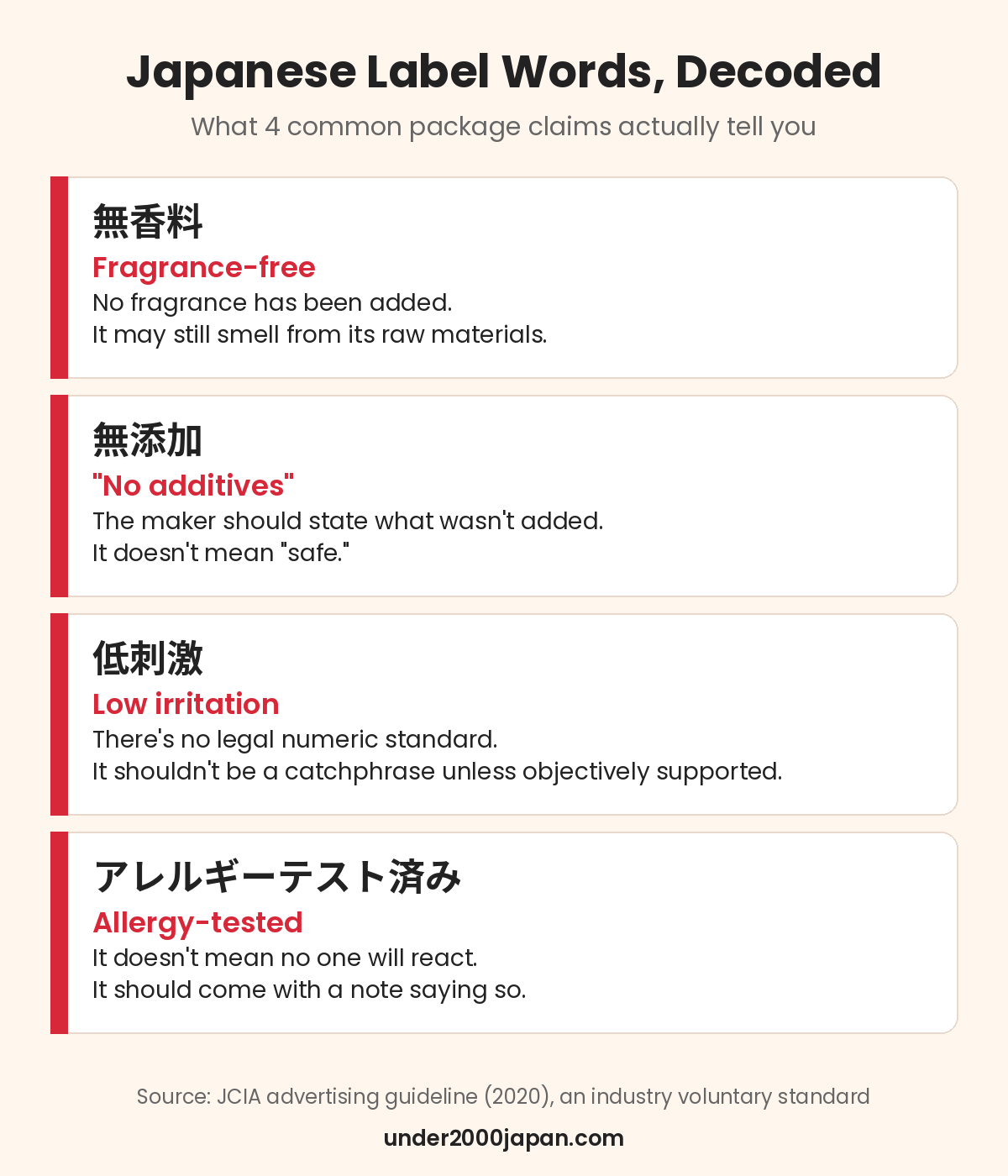
The takeaway: these words give you useful hints, but allergy-tested or “hypoallergenic” doesn’t mean you won’t react. Patch-test new products and check the full ingredient list.
You’ll also see words like 弱酸性 (weakly acidic) and アルコールフリー (alcohol-free). These are the maker’s own wording, so check the ingredient list if they matter to you. Some brands spell out exactly what they mean; 2e, for example, says “alcohol (ethyl alcohol) free” (Shiseido 2e).
Advantage 5: Everyday prices and simple, focused products
Under ¥2000 Japan exists because so many Japanese drugstore staples are made for everyday use at everyday prices. A few things about how pricing works in Japan:
- Many products, such as Hada Labo Gokujyun Hyaluronic Lotion, are sold at “open price” (オープン価格), which means there’s no manufacturer’s suggested retail price (Rohto). Shelf prices vary by store.
- Prices do change. Rohto announced a price revision in January 2026 for Hada Labo Gokujyun and other products, noting that store prices differ by retailer (Rohto).
- Prices you see overseas are a different story: imports and resellers add shipping and markups, so they won’t match Japanese shelf prices.
Many of these products are also built around one clear idea. Hada Labo’s Gokujyun line, for example, is a lotion line formulated with four types of hyaluronic acid (Rohto); we explain the ingredient in What is hyaluronic acid? A guide to Hada Labo.
Texture is another reason people try Japanese sunscreens. Many popular ones are light gel or essence types, such as Skin Aqua Super Moisture UV Essence (Rohto) and Biore UV Aqua Rich Watery Essence (Kao). Whether you like that feel is personal, and results vary.
For our picks by category, see Japanese drugstore beauty under ¥2000.
What Japanese skincare is not
To keep things honest, here’s what we’re not claiming:
- Made in Japan does not automatically mean better or safer for your skin.
- PA++++ is not proof of stronger UVA protection than a US Broad Spectrum sunscreen; the systems are different.
- Full ingredient lists are not unique to Japan.
- Quasi-drug doesn’t mean “works like a medicine.”
- Hypoallergenic or allergy-tested doesn’t mean no one will react.
The real advantages are practical: clear UVA grading on sunscreens, ingredient lists you can check, named active ingredients on quasi-drugs, label wording with guidelines behind it, and everyday prices.
How to get started
- Pick one product, not a whole routine. A lotion (化粧水) or a sunscreen is an easy first step.
- Read the label: SPF and PA on sunscreens, 有効成分 on quasi-drugs, and the full ingredient list.
- Patch-test before using it on your whole face.
- Put it in the right place in your routine. Our Japanese skincare routine order guide explains what goes first.
FAQ
Is Japanese skincare better than American skincare? We can’t say that, and no one fairly can as a blanket claim. What differs is labeling, like the PA rating (JCIA), and pricing. Results vary by person and product.
What does PA++++ mean? It’s the top grade in Japan’s industry UVA rating, meaning a measured UVAPF of 16 or more under ISO 24442 (JCIA).
Do Japanese products list all their ingredients? Cosmetics have done so, in principle, since 2001 (Tokyo Metropolitan Institute of Public Health). Fragrance can be listed as one word, 香料 (MHLW).
What is a quasi-drug (医薬部外品)? A Japanese category whose active ingredient is approved by the government (MHLW). It isn’t a medicine.
Did US sunscreen rules change in 2026? The FDA added bemotrizinol, at up to 6%, to its list of permitted sunscreen active ingredients, effective August 9, 2026 (FDA).
Final thoughts
The best reason to choose Japanese skincare isn’t a national label; it’s the information on the package. A graded UVA rating, a full ingredient list, a named active ingredient and everyday prices make it easier to choose. Start with one product, read the label, and see how your skin likes it.
Sources
- JCIA, SPF and PA notifications (English): https://www.jcia.org/en/common/download/top/jcia-notifications-spf-pa.pdf
- JCIA, UV protection voluntary standards: https://www.jcia.org/user/business/guideline/uvprotection
- JCIA, PA++++ news release (2012): https://www.jcia.org/user/common/download/approach/news_release/JCIA_release20121114-UV-PF.pdf
- JCIA, Advertising guideline for cosmetics (2020): https://www.jcia.org/user/common/download/business/advertising/JCIA20200615_ADguide.pdf
- US FDA, 21 CFR 201.327 (sunscreen labeling): https://www.govinfo.gov/content/pkg/CFR-2025-title21-vol4/pdf/CFR-2025-title21-vol4-sec201-327.pdf
- JCIA, Full ingredient labeling: https://www.jcia.org/user/business/ingredients/
- US FDA, Final Administrative Order OTC000039 (bemotrizinol): https://www.accessdata.fda.gov/drugsatfda_docs/omuf/Order/OTC000039_Final_Administrative_Order.pdf
- Federal Register, Amending OTC Monograph M020 (June 10, 2026): https://www.federalregister.gov/documents/2026/06/10/2026-11578/amending-over-the-counter-monograph-m020-sunscreen-drug-products-for-over-the-counter-human-use-and
- European Commission, Sunscreen products: https://single-market-economy.ec.europa.eu/sectors/cosmetics/cosmetic-products-specific-topics/sunscreen-products_en
- EUR-Lex, Commission Recommendation 2006/647/EC: https://eur-lex.europa.eu/eli/reco/2006/647/oj
- Tokyo Metropolitan Institute of Public Health, 2000 notice on full ingredient labeling: https://www.tmiph.metro.tokyo.lg.jp/files/k_yakuji/i-sinsa/cosmetics/tsuuchi/200009290929.pdf
- Tokyo Metropolitan Institute of Public Health, cosmetic labeling: https://www.tmiph.metro.tokyo.lg.jp/k_yakuji/i-kanshi/c_label/
- MHLW, ingredient labeling notice (2001): https://www.mhlw.go.jp/web/t_doc?dataId=00ta7768&dataType=1&pageNo=1
- MHLW, Cosmetics and quasi-drugs: https://www.mhlw.go.jp/stf/seisakunitsuite/bunya/kenkou_iryou/iyakuhin/keshouhin/index.html
- PMDA, Quasi-drugs: https://www.pmda.go.jp/review-services/drug-reviews/about-reviews/q-drugs/0001.html
- Shiseido 2e: https://www.shiseido.co.jp/2e/products/emulsion.html
- Rohto, Hada Labo Gokujyun Hyaluronic Lotion: https://jp.rohto.com/hadalabo/gokujun-lotion/
- Rohto, 2026 price revision notice: https://www.rohto.co.jp/news/release/2026/0115_02/
- Rohto, Skin Aqua Super Moisture UV Essence: https://jp.rohto.com/skin-aqua/super-moisture-essence
- Rohto, Melano CC serum: https://jp.rohto.com/melanocc/essence/
- Kao, Biore UV: https://www.kao.co.jp/bioreuv/