What Is Hyaluronic Acid? A Plain-English Guide (and Why Hada Labo Uses So Many Kinds)
Disclosure: This guide contains no affiliate links. Some posts on Under ¥2000 Japan do, and if you buy through them we may earn a small commission at no extra cost to you. We have not tested the products mentioned here; label details come from the makers’ official pages.
Hyaluronic acid is everywhere in Japanese drugstores. It’s printed in big letters on lotions, it’s in sheet masks, and one famous bottle, Hada Labo’s Gokujyun Premium Lotion, says it contains eight kinds of it. But what is hyaluronic acid, and why would one bottle need eight versions?
This guide explains it in plain English: what the ingredient is, what it does on skin (and what it doesn’t), what “molecular weight” means, and how to spot it on a Japanese label. It’s an explainer, not a product roundup. For prices and where to buy, see our Japanese drugstore beauty under ¥2000 guide.
This article is general information, not medical advice. If you have a skin condition, or a product irritates your skin, talk to a dermatologist or pharmacist.
What is hyaluronic acid?
Hyaluronic acid (often shortened to HA) isn’t a harsh “acid” like the exfoliating kind. It’s a substance your own body makes: a peer-reviewed review describes it as an important component of the extracellular matrix, the material between skin cells, and notes that HA in the dermis helps regulate water balance (Bravo et al., Journal of Cosmetic Dermatology, PMC).
The same review states that HA is “a hygroscopic molecule with the ability to bind 1000 times its volume in water” (PMC). That water-loving quality is why skincare makers put it in their formulas.
How it works on skin: a humectant
In skincare, HA is classed as a humectant, an ingredient that attracts and holds water (PMC review; Draelos et al., Dermatology and Therapy, 2021, PMC). The second paper puts it simply: HA “acts as a biologic humectant, thus retaining water in the skin,” which makes it useful as a topical moisturizing ingredient (PMC).
The American Academy of Dermatology (AAD) lists hyaluronic acid among the ingredients to look for in a cream or ointment for dry skin (AAD), and an AAD article quotes a dermatologist describing it as “known for its intense moisturizing qualities” (AAD).
So the honest summary is: HA helps skin hold moisture. It’s a hydrating ingredient, not a miracle cure, and results vary from person to person.
Types and molecular sizes: why “size” matters
HA is a long chain-like molecule, and it can be made in different lengths. Scientists describe the length by molecular weight, measured in kilodaltons (kDa). Roughly:
| Type | What research says | Source |
|---|---|---|
| High molecular weight (HMW) HA | Has “very limited permeability through the skin and primarily stays on the skin’s surface,” forming a thin hydration layer | PMC review |
| Low molecular weight (LMW) HA | Can permeate the outer layer of skin (stratum corneum) | PMC review |
Some numbers, as stated in the research: a Raman spectroscopy study found that HA of 20–300 kDa passed through the stratum corneum, while HA of 1,000–1,400 kDa did not (Essendoubi et al., Skin Research and Technology, 2016). The Draelos paper cites the same finding (Draelos et al., 2021).
That’s the logic behind products that combine several types: different sizes are thought to behave differently, so a blend aims to cover more than one. For example, the HA serum tested in the Draelos study combined hydrolyzed 50 kDa HA with 10–1,000 kDa sodium hyaluronate (PMC). Keep in mind that a study on one formula doesn’t tell you how a different product will perform.
How to use it (general tips)
There’s no single “right” way, and the product’s own directions come first. But the AAD’s general moisturizing advice applies well to hydrating products:
- Apply to damp skin. The AAD suggests applying moisturizer when your skin is still damp after a shower or bath (AAD), because it helps trap water in the skin (AAD).
- Dry skin may need something richer on top. The AAD says creams and ointments add more moisture and are more effective than lotions for dry skin (AAD). A watery Japanese 化粧水 (lotion/toner) is usually one step, often followed by a cream.
- Watch for fragrance if you’re sensitive. An AAD article advises avoiding fragranced products if your skin is dry, as fragrance can be irritating (AAD). That’s where the label word 無香料 (fragrance-free) comes in handy.
Hyaluronic acid on Japanese labels
Japanese ingredient lists use Japanese names. Here are words you’re likely to see:
| Japanese | Reading | English |
|---|---|---|
| ヒアルロン酸 | hiaruron-san | Hyaluronic acid |
| ヒアルロン酸Na | hiaruron-san natoriumu | Sodium hyaluronate (the sodium salt of HA) |
| 加水分解ヒアルロン酸 | kasui-bunkai hiaruron-san | Hydrolyzed hyaluronic acid |
| アセチルヒアルロン酸Na | asechiru hiaruron-san natoriumu | Sodium acetylated hyaluronate |
| ヒアルロン酸クロスポリマーNa | hiaruron-san kurosu porimā natoriumu | Sodium hyaluronate crosspolymer |
| うるおい成分 | uruoi seibun | Moisturizing ingredient |
| 保湿 | hoshitsu | Moisturizing |
| 化粧水 | keshōsui | Lotion / toner |
| 弱酸性 | jaku-sansei | Weakly acidic (mildly acidic) |
| 無香料 | mukōryō | Fragrance-free |
| 無着色 | muchakushoku | No added colorants |
| アルコール(エタノール)フリー | arukōru (etanōru) furī | Alcohol (ethanol)-free |
| パラベンフリー | paraben furī | Paraben-free |
Tip: look for ヒアルロン in the ingredient list (成分). Anything containing that string is a form of HA.
Example: why Hada Labo Premium Lotion lists 8 kinds
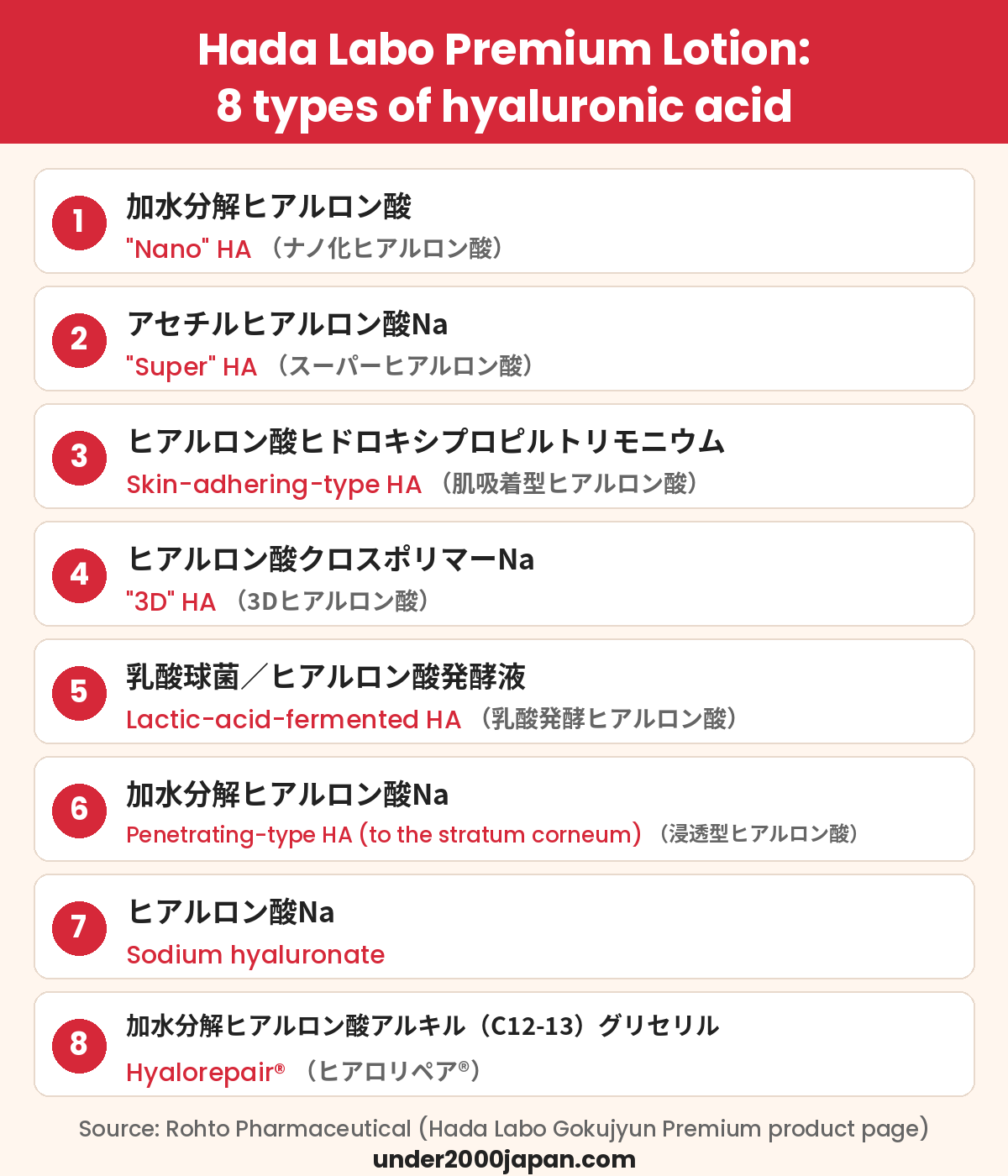
Rohto’s official page for Hada Labo Gokujyun Premium Lotion (肌ラボ 極潤プレミアム ヒアルロン液) describes it as a high-moisture lotion (高保湿化粧水) containing 8 types of hyaluronic acid (moisturizing ingredients) (Rohto official). Rohto’s campaign page calls it the most types of HA in Hada Labo’s history (肌ラボ史上最多) (Rohto official).
Here are the eight, exactly as Rohto lists them, with Rohto’s own nicknames in brackets (Rohto official):
| Ingredient name (label) | Rohto’s nickname | Our literal translation of the nickname |
|---|---|---|
| 加水分解ヒアルロン酸 | ナノ化ヒアルロン酸 | “Nano” HA |
| アセチルヒアルロン酸Na | スーパーヒアルロン酸 | “Super” HA |
| ヒアルロン酸ヒドロキシプロピルトリモニウム | 肌吸着型ヒアルロン酸 | Skin-adhering-type HA |
| ヒアルロン酸クロスポリマーNa | 3Dヒアルロン酸 | “3D” HA |
| 乳酸球菌/ヒアルロン酸発酵液 | 乳酸発酵ヒアルロン酸 | Lactic-acid-fermented HA |
| 加水分解ヒアルロン酸Na | 浸透型ヒアルロン酸 | Penetrating-type HA (Rohto notes: “to the stratum corneum,” 角質層まで) |
| ヒアルロン酸Na | – | Sodium hyaluronate |
| 加水分解ヒアルロン酸アルキル(C12-13)グリセリル | ヒアロリペア® | Hyalorepair® |
Rohto doesn’t state molecular weights for these on its product page, so we won’t guess. What we can say is that the list mixes standard sodium hyaluronate with hydrolyzed (broken-down) forms and modified forms, which fits the general idea above that different HA types are used for different roles.
Other details from the official page: weakly acidic (弱酸性), fragrance-free, colorant-free, oil-free, alcohol (ethanol)-free and paraben-free; sold as a 170mL bottle and a 170mL refill (Rohto official). The full ingredient list is on Rohto’s ingredient page.
Japan price, overseas price and where to buy: see our drugstore beauty under ¥2000 guide. Versions sold outside Japan may be labeled differently.
Who might like it, and why patch test first
HA-based lotions may appeal to people looking for a simple hydrating step, especially in dry weather. But “gentle-sounding” doesn’t mean it suits everyone; any product can irritate some people.
The AAD recommends testing a new product before adding it to your routine (AAD):
- Apply it to a quarter-sized spot, such as the underside of your arm or the bend of your elbow, twice a day for 7 to 10 days.
- If you get no reaction, such as red, itchy or swollen skin, go ahead and use it.
- If you do react, wash it off and don’t use it again.
Rohto’s own caution notes for this lotion also say not to use it on broken or irritated skin, and to stop and consult a dermatologist if you notice redness, swelling, itching or irritation (Rohto official).
FAQ
Is hyaluronic acid an exfoliating acid? No. It’s a humectant that helps skin hold water (PMC), and it occurs naturally in skin (PMC).
Is “ヒアルロン酸Na” different from hyaluronic acid? It’s the sodium salt form, which is what most labels list. Rohto counts ヒアルロン酸Na as one of the 8 HA types in Premium Lotion (Rohto official).
Does low molecular weight HA go deeper? Research suggests lower-weight HA (20–300 kDa) can pass the outer skin layer while high-weight HA mostly stays on the surface (Essendoubi et al., 2016; Draelos et al., 2021). That doesn’t automatically mean one is “better” for you.
Is more types of HA always better? Not necessarily. A blend is a formulation choice; we haven’t seen evidence that a higher count alone means better results, and we haven’t tested these products.
Can I use it if I have sensitive skin? Patch test first, as the AAD recommends (AAD), and ask a dermatologist if you have a skin condition.
Final thoughts
Hyaluronic acid is a water-loving ingredient your skin already contains, used in skincare as a humectant to help skin hold moisture. Different sizes and forms behave differently, which is why brands like Hada Labo blend several. On a Japanese label, just look for ヒアルロン and you’ve found it.
For a wider look at what Japanese labels tell you, see Why choose Japanese skincare?
Sources
- Rohto, Hada Labo Gokujyun Premium Lotion (official product page): https://jp.rohto.com/hadalabo/gokujun-premium-lotion/
- Rohto, Hada Labo Gokujyun Premium campaign page: https://jp.rohto.com/hadalabo/promo/g-premium/
- Rohto, ingredient list (JAN 4987241167012): https://jp.rohto.com/seib/seib/?kw=167012
- Bravo B. et al., “Benefits of topical hyaluronic acid for skin quality and signs of skin aging,” Journal of Cosmetic Dermatology (PMC): https://pmc.ncbi.nlm.nih.gov/articles/PMC10078143/
- Draelos Z.D. et al., “Efficacy Evaluation of a Topical Hyaluronic Acid Serum in Facial Photoaging,” Dermatology and Therapy (PMC): https://pmc.ncbi.nlm.nih.gov/articles/PMC8322246/
- Essendoubi M. et al., “Human skin penetration of hyaluronic acid of different molecular weights as probed by Raman spectroscopy,” Skin Research and Technology, 2016: https://onlinelibrary.wiley.com/doi/10.1111/srt.12228
- American Academy of Dermatology, Dermatologists’ top tips for relieving dry skin: https://www.aad.org/public/everyday-care/skin-care-basics/dry/dermatologists-tips-relieve-dry-skin
- American Academy of Dermatology, How to pick the right moisturizer for your skin: https://www.aad.org/public/everyday-care/skin-care-basics/dry/pick-moisturizer
- American Academy of Dermatology, How to test skin care products: https://www.aad.org/public/everyday-care/skin-care-secrets/prevent-skin-problems/test-skin-care-products